I have been following Counter-Strike 2 esports for years, and the latest announcement from ESL feels like one of those moments that separates adaptable players from everyone else. On January 21, 2026, the ESL Pro Tour officially confirmed that every upcoming event would be played on the newest CS2 patch. Starting with the current qualification cycle for IEM Rio 2026, absolutely all matches — both online and on LAN — are moving to the updated version of Anubis. For a regular viewer like me, this is a welcome change, but I can feel the tension building for the professionals.

The most fascinating part is how quickly the timeline moved. By January 22, teams were already grinding the redesigned Anubis layout and adjusting to the revised jumping mechanics. Valve also decided to alter the weapon balance in a pretty dramatic way: the MP7 and MP5-SD have become noticeably more lethal. As someone who loves close-range engagements, I can only imagine how much impact these weapons will have on force buys and half-buys. A single SMG upgrade can now flip a round economy, which means early-game decisions will be even more punishing. The update itself landed right on the opening day of the IEM Rio selections, and the pressure was immediate. Fnatic and the British Columbia team were among the first to test their luck; the latter, honestly, went out in the very first round. With sixteen teams competing for only two spots in the April main event, every single map feels like a final.
The switch is not limited to online qualifiers. Tier 1 heavyweight tournaments are included, and the first major test is the IEM event in Krakow, running from January 28 to February 8. ESL has taken a pioneering role here, while BLAST has chosen a different path. For their second week of BLAST Bounty, BLAST remained on the old beta version. That means viewers will not see the new Anubis on BLAST broadcasts, and the competitive ecosystem is split. I have to admit this contrast feels strange. Competitive CS2 rarely gets a fully unified patch rollout, and even in 2026, organizers still seem unwilling to move in lockstep.
A Packed ESL Calendar in 2026
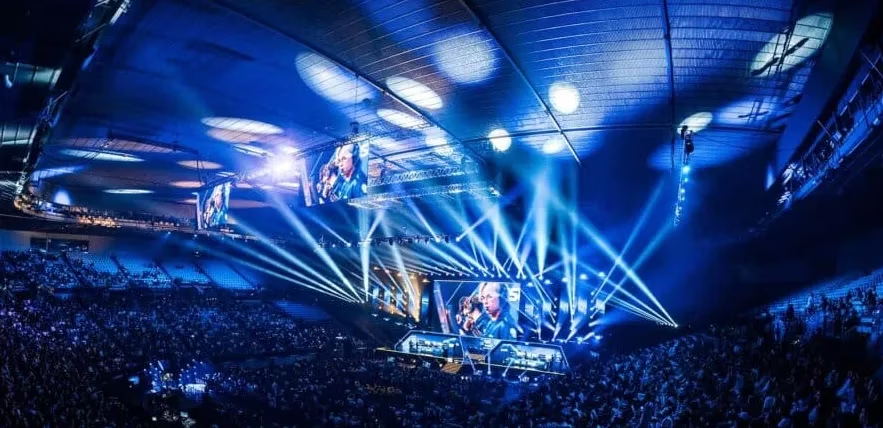
The schedule is extremely dense. The 2026 season begins in Krakow, where 24 top rosters will fight for a $1 million prize pool — roughly 744,463 pounds. That is the kind of money that makes every utility lineup and jump timing matter.
-
🗓️ ESL Pro League Season 23 and Season 24
-
🌍 Major IEM stops in Atlanta, Rio, China, and Cologne
-
🏆 The season finale, the 24th major in Cologne, set for June
Why the Early Patch Switch Matters
For me, the rush to upgrade is really a flexibility test. The teams that adapt to the changed Anubis layout and movement mechanics faster will likely take the early trophies. There is no hidden formula: the fastest learners survive. I also think this creates a split-screen viewing experience. ESL fans will see the new build, while BLAST fans may watch an older competitive version. It could feel confusing for newcomers, but for veterans like me it simply shows how fragmented the professional scene still is.
| Competition | Details |
|---|---|
| IEM Krakow | January 28 to February 8, Tier 1 opener with a $1 million prize pool |
| IEM Rio 2026 | Qualifiers underway on the new patch; only two April main event spots are available |
| ESL Pro League | Season 23 and Season 24 are on the calendar |
| Major IEM stops | Atlanta, Rio, China, and Cologne |
| Season finale | 24th major in Cologne, scheduled for June |
I expect the opening weeks of the ESL Pro Tour to be full of surprises. The updated Anubis will reward teams that study every angle, every boost spot, and every new timing. At the same time, the stronger SMG presence could make eco rounds much more dangerous, so no lead will feel completely safe. Watching the Krakow event should give us an early signal about which rosters are truly prepared for the 2026 grind. Personally, I am already clearing my schedule for those first matches.