I have a ritual. Every year, a new Call of Duty drops, and I make a beeline for the campaign. There’s something about those six-hour interactive action movies—the over-the-top characters, the globe-trotting set pieces, the jargon-filled plots—that I can’t resist. The Modern Warfare reboot had me completely hooked, right up until the rushed third installment that, in my opinion, fumbled the entire narrative arc. Now, as we look toward Black Ops 6, I see glimmers of hope in its promise to blend nostalgia with innovation. But that’s just one part of the story. The truth is, for a longtime fan like me, everything outside the campaign has become a bewildering, alien landscape. When did the simple act of playing a few rounds of multiplayer become such a chore?
Remember the days of popping in a disc, booting up the game, and being mere seconds from shooting your friends on Rust? Those days feel like ancient history. The Call of Duty I grew up with was the definition of an approachable shooter. Now, it’s a live-service leviathan, a digital mall where the primary currency seems to be your time and attention. The shift began with the monolithic rise of Warzone, but it has since consumed the entire ecosystem. The game is no longer just a game; it’s a platform, a service, a constant demand for engagement. Is this evolution, or is it a loss of identity?
Let me paint you a picture of my typical experience in 2025. I fire up Modern Warfare 3, eager to revisit some classic maps. What greets me is not a lobby, but an obstacle course. I’m immediately presented with a hub—a cold, impersonal interface that seems designed to push me toward Warzone, a mode I have zero interest in. To even find the standard multiplayer, I must navigate a labyrinth of notifications, promotional banners, and tabs. I scroll, I select "Modern Warfare 3," I select "Multiplayer," and then I’m faced with another layer of menus to filter the specific game modes I want. All this, just to avoid being dumped into a random playlist. The user interface is clunky, sluggish, and feels actively hostile to the simple pleasure of jumping into a quick match. It’s a far cry from the streamlined menus of the past. What was once a direct path to fun is now a series of bureaucratic checkpoints.
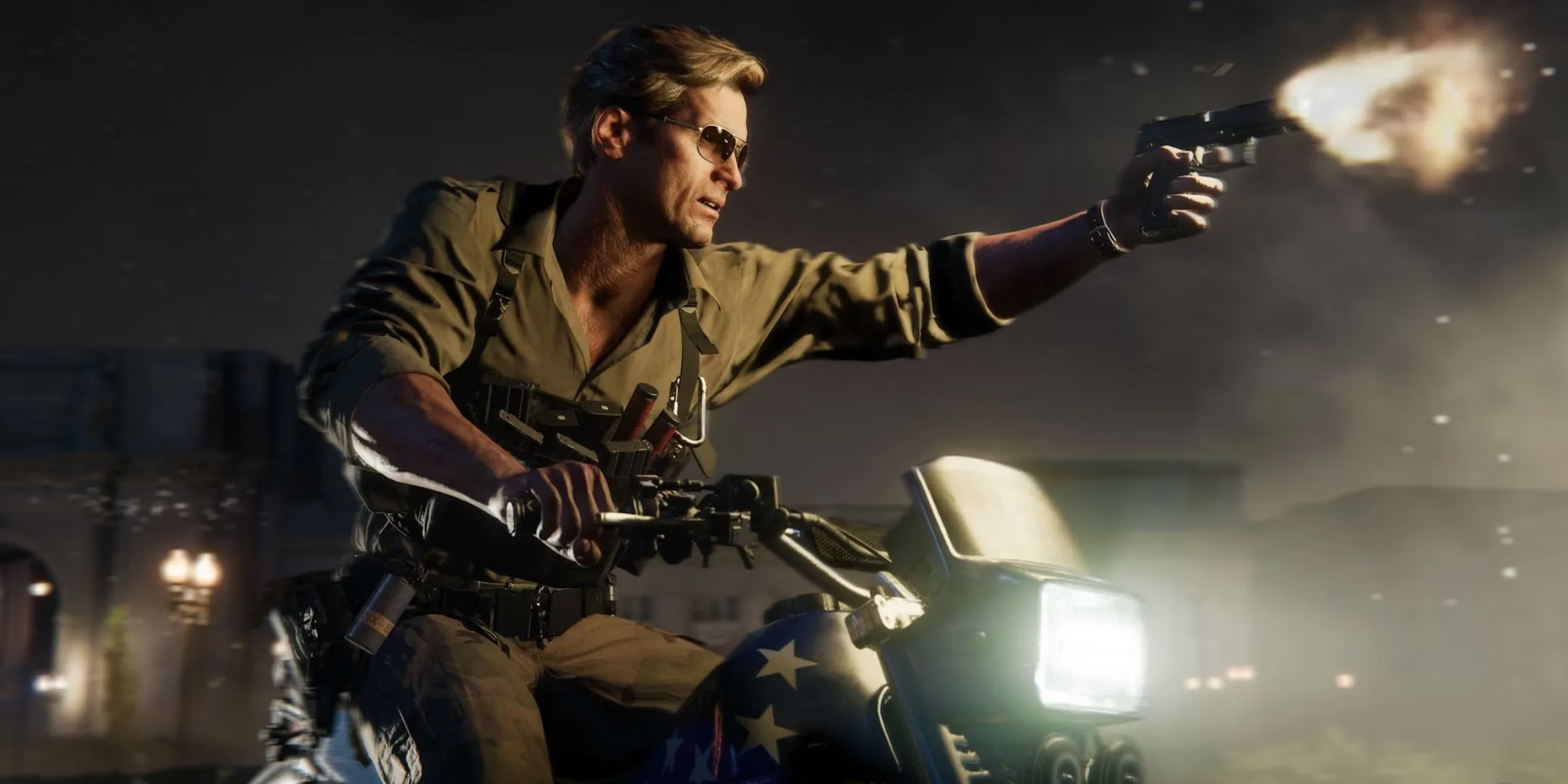
This complexity is only the beginning. Modern Warfare 3 was heavily marketed on its nostalgic core: remastered versions of every map from the original Modern Warfare 2. As someone who spent countless teenage hours on those very maps, this was a huge selling point for me, a beacon of familiarity in a changing series. But here’s the cruel irony: actually playing on these classic maps has become a rare event. Months after the game’s launch, I’ll queue up, and matchmaking consistently throws me into newer, often less-inspired locations. When I do finally land a game on Karachi or Terminal, it’s a bittersweet victory. The maps are there, but they feel... off. They’re often stretched into larger spaces, bathed in garish new lighting that strips away their original mood. The faster, slide-heavy movement of the new engine clashes awkwardly with level geometry designed for a slower-paced game from over a decade ago. It doesn’t feel like a loving remaster; it feels like a skin stretched over a different skeleton. I can see my old haunts, but I can’t truly feel them anymore. The experience makes me yearn for the past while simultaneously wincing at the present.
And then there’s the world that now exists within the game. Load up any Call of Duty title today, and you’re not just entering a military shooter. You’re entering a cross-promotional theme park. The storefront is no longer just for weapon blueprints or operator skins; it’s a revolving door of pop culture. One week you can play as Homelander from The Boys, the next you’re piloting a Gundam mech or running around as a WWE superstar or a Vault Dweller from Fallout. The sheer volume is staggering:
-
Iconic Characters: Homelander, Starlight, Gundam pilots, John Cena.
-
Franchise Crossovers: The Boys, Gundam, WWE, Fallout, Spawn.
-
Thematic Seasons: Each season brings a completely new, often unrelated, theme that overrides the game’s core aesthetic.
Call of Duty has unabashedly followed in Fortnite’s footsteps, striving to have its finger on the pulse of every trending franchise. But at what cost? The game’s own identity—that grounded, if exaggerated, military aesthetic—has been diluted into a chaotic mash-up. It no longer feels like a coherent world; it feels like a digital billboard for whatever is hot this month. The constant churn of content isn’t about deepening the gameplay; it’s about maintaining a relentless cycle of novelty to keep players hooked and spending. Is this what we wanted?
This brings me to Black Ops 6. On the surface, it’s pushing all the right buttons for a veteran like me. A campaign that promises to revisit beloved characters and continue storylines from Cold War and Black Ops 2, taking us to the Gulf War? Sign me up. I’ll be there on day one, ready for that classic, cheesy, high-stakes narrative. But I’m no longer naive. I know exactly what will happen a couple of months after launch. That carefully crafted campaign will become a distant memory, buried under an avalanche of:
-
Weekly Store Drops: New crossover bundles every few days.
-
Seasonal Overhauls: Drastic changes to the map pool and meta.
-
Event Grinds: Limited-time modes tied to battle pass progression.
The core multiplayer experience will be lost in the noise, another piece of content in a machine desperate to stay relevant in the brutal live-service battleground. Even a giant like Call of Duty isn’t immune to being left behind. The pressure to constantly update, to always have a new "thing," is immense. In this environment, the soul of the game—the tight, balanced, map-focused multiplayer that defined a generation—feels like an afterthought.
So, where does that leave someone like me? I’m a campaign fan trapped in a multiplayer world I no longer recognize. I’ll play Black Ops 6 for its story, and I might dabble in its multiplayer at the start, but I know the feeling won’t last. The simplicity is gone, replaced by complexity. The identity is gone, replaced by a cacophony of crossovers. The game I fell in love with as a teenager, the one that felt unstoppable, has evolved into something else entirely. It’s bigger, brasher, and more profitable than ever. But for this loser who just loves a good six-hour blockbuster campaign and some straightforward multiplayer mayhem, it often feels like it’s no longer my game. It’s a service, and I’m just a user passing through its crowded, noisy halls, occasionally catching a glimpse of the ghost of what it used to be.