The moment you unbox the Logitech G PRO X2 SUPERSTRIKE in 2026, it’s clear this mouse isn’t just another iteration—it’s a statement. Built from the ground up with over 180 esports professionals across Counter-Strike 2, Valorant, Rainbow 6 Siege, League of Legends, and more, the SUPERSTRIKE’s entire existence orbits one idea: deleting every possible delay between what your brain commands and what happens on screen. And honestly? It feels like it.
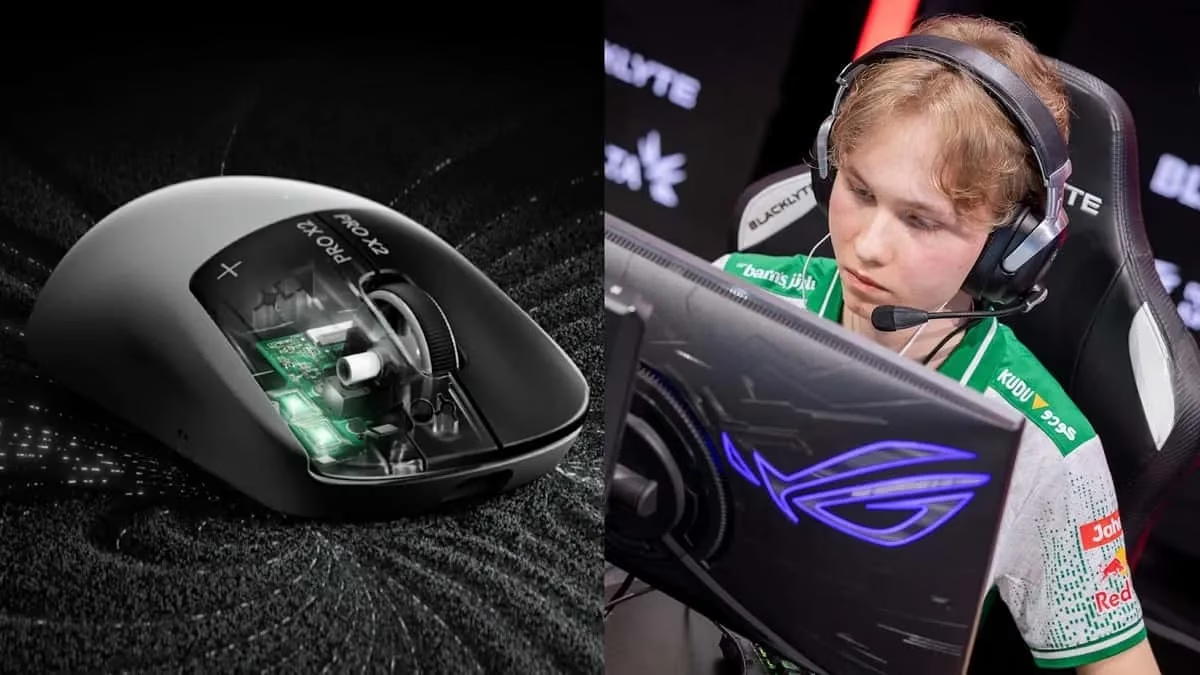
At the heart of this beast is something Logitech calls the Haptic Inductive Trigger System, or HITS for short. Think of it as a love letter to speed-freaks. Instead of relying on those tiny physical microswitches that have been clicking away inside gaming mice for decades, HITS uses inductive sensors coupled with real-time haptic feedback. The result? Clicks that register faster, reset quicker, and feel identical whether you’re five minutes or five hours into a session. We’re talking up to a 30-millisecond reduction in latency compared to traditional mechanical clicks. In a world where a single frame can decide a round, that margin is, well, kind of absurd.
But here’s where things get really interesting: HITS hands control back to the player in ways no mouse has really dared to before. Through Logitech’s G HUB software, users can fiddle with ten different actuation points and five rapid trigger values on the main buttons. Want your left click to fire off after barely breathing on it? Done. Prefer a deeper press with a snappier reset for burst tapping? Just drag a slider. There are even six levels of haptic intensity you can tweak, so the click feel can be as pronounced or as whisper-quiet as you like. Dial the haptics down to zero, and the SUPERSTRIKE becomes completely silent—a dream for late-night grinders and streamers who don’t want their audience to hear a constant clack-clack-clack.
It’s the kind of customization that keyboard enthusiasts have been spoiled with for years, but seeing it finally land on a mouse makes you wonder why nobody pulled the trigger sooner. “The rapid trigger makes it noticeably faster and more responsive than traditional mice,” said G2’s AWPer SunPayus after making the switch. “On top of that, its shape is identical to the Superlight 2, which makes the transition seamless—that’s a major advantage.”
And that shape? Let’s not gloss over it. Logitech has wisely kept the championship-proven silhouette that’s been a staple on competitive desks for nearly a decade. The PRO X2 SUPERSTRIKE feels instantly familiar to anyone who’s ever gripped a Superlight. But the visuals got a bold makeover. Gone is the single-color minimalism; in its place is a striking two-tone shell with a white body, black main buttons, and prominent PRO X2 branding. It’s unapologetically esports, and somehow still manages to look clean rather than chaotic.
Under the hood, the sensor is Logitech’s most advanced yet—tracking over 888 inches per second, handling up to 88 Gs of acceleration, and reaching a dizzying 44,000 DPI. LIGHTSPEED wireless keeps the connection wired-tight, ensuring there’s no interference when tournament nerves are already doing enough damage. But let’s be real: the spec sheet stuff is table stakes at this level. What makes the SUPERSTRIKE sing is how all these pieces come together in actual gameplay.
Take m0NESY from Falcons, for example. The young star didn’t mince words about what the mouse changed for him: “I think the biggest benefit I’ve got after using the new SUPERSTRIKE is the speed of pressing the mouse, meaning I click and aim faster. That is an advantage for sure. And the second benefit is just the comfort of pressing mouse1 and mouse2. I don’t need to press hard, which is beneficial for long games.” There’s something deeply human about that—when your gear stops fighting you, you can finally focus on the game itself.
In tactical shooters, faster reset points translate directly into tighter spray control and quicker follow-up shots. Pros like sdy have gone so far as to call the rapid trigger feature “game-changing,” and it’s easy to see why. If you’ve ever strafed with a keyboard that supports rapid trigger, you know the feeling: the instant you start to lift a key, the input releases, letting you dance around corners with surreal fluidity. Now imagine that same responsiveness on your mouse buttons. Spam-clicking in a close-range duel feels telepathic. Peeking and pre-firing become a single, seamless motion. It doesn’t magically make you a better player overnight, but it raises the mechanical ceiling sky-high—and for the dedicated grinder, that’s everything.
Of course, it’s not all about FPS. League of Legends players are finding just as much to love, though for slightly different reasons. FlyQuest mid laner Gryffinn highlighted comfort and customization: “The best advantage I experience with the SUPERSTRIKE is the comfort and fit of the shape. It’s incredibly natural. The click customization is on another level and is a feature I’m looking forward to playing with more.” In MOBAs, where actions-per-minute can hit dizzying peaks, the consistency of those clicks—and not having to press like you’re trying to crack a walnut—makes a genuine difference over a best-of-five series.
So what does all this mean for the average player in 2026? You don’t need to be a pro to appreciate a mouse that feels like an extension of your hand. The SUPERSTRIKE isn’t trying to reinvent the wheel; it’s sharpening the wheel to a razor’s edge. The combination of haptic induction, tunable actuation, and that battle-tested shape creates a tool that respects your muscle memory while offering genuinely new layers of control. If you’ve ever been frustrated by click inconsistency, or just wondered if your hardware was holding you back by a few milliseconds, this mouse basically answers, “Yeah, maybe it was. Here, let’s fix that.”
Logitech has a history of setting trends in the competitive scene, and with the PRO X2 SUPERSTRIKE, they’ve done it again. It’s not just a refresh; it’s a quiet revolution—literally quiet, if you dial those haptics down. And in the relentless arms race of esports, that whisper might just be the loudest statement yet.