Imagine settling into a comfortable gaming rhythm, bonding with a digital hero whose every scar and smirk you've come to know intimately—only to have the virtual rug violently yanked from beneath your feet! In the gaming world of 2026, developers continue to master the art of the protagonist swap, executing narrative curveballs that leave players reeling like a sailor caught in a sudden tempest. These aren't mere character cameos or temporary shifts; these are seismic, story-altering transfers of player agency that transform the entire experience. From ancient Egypt to futuristic battlefields, these games dared to kill, demote, or dramatically reframe their leading figures, creating moments as shocking as a magician revealing the volunteer from the audience was the real illusionist all along.
🎭 The Art of Narrative Betrayal: Why Developers Pull the Switch
Game creators employ protagonist swaps for reasons as varied as the games themselves:
| Reason for Swap | Narrative Purpose | Player Impact |
|---|---|---|
| Hero's Death | Create emotional weight & legacy | Shock, grief, motivation for new character |
| Perspective Shift | Show multiple sides of conflict | Expanded world understanding |
| Revelation Twist | Subvert player assumptions | Mind-blowing "aha!" moment |
| Generational Story | Bridge between eras/games | Satisfying continuity payoff |
These swaps are narrative gambles as daring as a tightrope walker deciding mid-performance to switch to juggling chainsaws—when they work, they're unforgettable; when they fail, they're catastrophic.
🗡️ 9. Assassin's Creed Origins: The Husband-Wife Revenge Duet
In the sun-baked sands of Ancient Egypt, players spent dozens of hours as Bayek, a Medjay warrior whose quest for vengeance felt as personal as a scar. His journey to avenge his son's death consumed the narrative like a desert consuming water. Yet, in a twist as unexpected as finding an oasis in a sandstorm, the final act handed control to his wife, Aya. Suddenly, players weren't just finishing a story—they were experiencing its culmination through the eyes of its other wounded heart. This wasn't a demotion for Bayek but an expansion of the revenge fantasy, proving that some wounds require two souls to heal.
⚙️ 8. Gears 5: From Golden Boy to Broken Man
The transformation of JD Fenix in Gears 5 remains one of gaming's most brutal character descents. Starting as the confident COG soldier was like piloting a gleaming starship—until the Hammer of Dawn incident turned that ship into space debris. His physical and psychological scarring didn't just change his personality; it changed his role in the story. The baton passed to Kate Diaz as smoothly as a relay runner handing off the stick, yet the emotional whiplash lingered. Kate's journey into her family history felt like opening a secret compartment in a familiar weapon, revealing mechanisms you never knew existed.
🕵️ 7. L.A. Noire: The Fall From Grace
Playing Cole Phelps ascend the L.A.P.D ranks in 1947 was like watching a meticulously constructed house of cards—impressive until one ill-advised breath topples everything. His affair and subsequent demotion to the arson desk didn't just change his desk; it changed the player's avatar. Enter Jack Kelso, the claims investigator who picked up the conspiracy thread Phelps dropped. The switch felt less like changing drivers and more like discovering your car has a completely different engine under the hood—one that runs on cynicism instead of ambition.
⚔️ 6. Assassin's Creed 3: The Ultimate Templar Deception
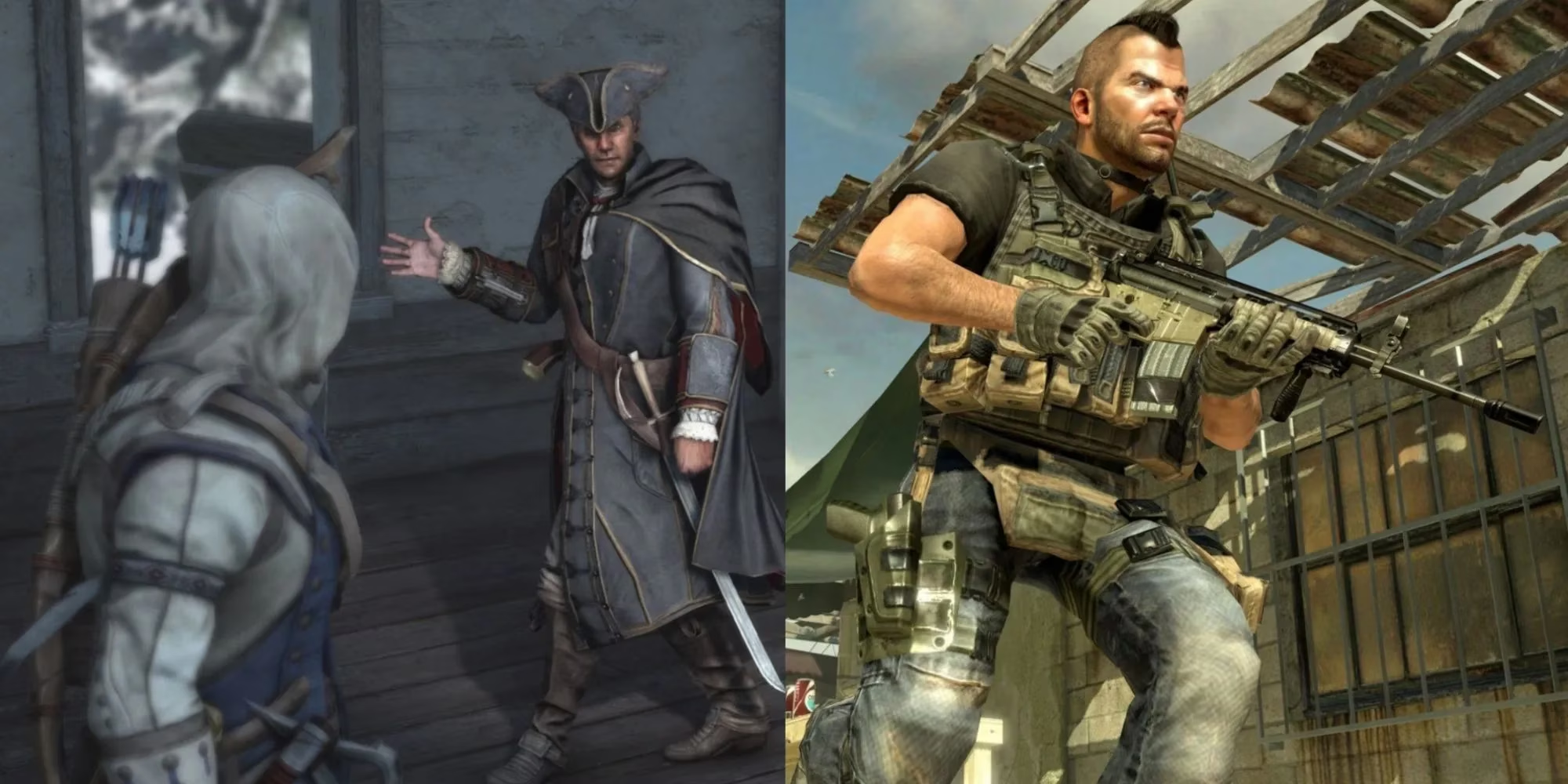
Haytham Kenway's opening hours in Assassin's Creed 3 represent gaming's greatest narrative sleight of hand. Wielding a hidden blade and performing stealth kills, he presented as the ultimate Assassin—until the revelation that he was actually a Templar hit with the force of a historical anvil dropping from a colonial church steeple. Switching to his son Connor wasn't merely a protagonist change; it was a complete ideological realignment. Players had to recalibrate their entire moral compass mid-journey, a feat as disorienting as discovering the map you've been following is actually a treasure map to a different treasure entirely.
🌊 5. Bioshock Infinite: Burial At Sea - Booker's Watery Grave
This expansion's protagonist swap operates on metaphysical levels that would give philosophers headaches. Controlling Booker in Rapture's decaying art deco halls felt familiar until memories of being the monstrous Zachary Comstock resurfaced like corpses from the ocean depths. His death and the subsequent shift to Elizabeth for Episode Two transformed the experience from a detective story to a survival horror tale. Elizabeth's journey through a dying Rapture felt like switching from conducting an orchestra to being a soloist in a requiem—the same music, but infinitely more personal and desperate.
🔫 4. Call Of Duty: Modern Warfare 2 - The Roach Betrayal
Modern Warfare 2's campaign juggled soldiers like a circus performer with too many knives, but Roach felt like the main blade—until General Shepherd's betrayal turned that knife on its wielder. The "No Russian" mission might get headlines, but Roach's death and the subsequent shift to Soap MacTavish delivered a different kind of shock: the shock of continuity. Bringing back the protagonist from Call of Duty 4 felt like finding your old trusty sword after breaking your flashy new one—familiar, reliable, and sharpened by nostalgia.
🤼 5. WWE '12: The Triple-Threat Narrative
WWE '12 didn't just swap protagonists—it built its entire story mode around the concept like a wrestling match built around three competitors. The three-arc structure featuring Sheamus, Triple H, and created wrestler Jacob Cass was less a linear story and more a narrative tag-team match where the tag happens between chapters rather than during them. This approach felt like reading three interconnected novellas bound in the same cover, each with its own hero but contributing to a larger championship belt of storytelling.
🐍 2. Metal Gear Solid 2: Gaming's Most Infamous Bait-and-Switch
The protagonist swap in Metal Gear Solid 2 remains the industry standard for player whiplash. Playing as Solid Snake in the Tanker chapter established expectations as firmly as concrete—then the game poured acid on that concrete and introduced Raiden. Fan backlash was volcanic, but history has been kinder to Hideo Kojima's gamble. The switch from grizzled veteran to rookie operative served the story's themes of information control and identity in ways that would have been impossible with Snake alone. It was like preparing for a symphony and getting an experimental jazz album—disorienting at first, but groundbreaking upon reflection.
🤠 1. Red Dead Redemption 2: Arthur's Last Ride & John's New Dawn
No protagonist swap carries the emotional weight of Red Dead Redemption 2's transition from Arthur Morgan to John Marston. Arthur's tuberculosis diagnosis and gradual decline played out with heartbreaking inevitability, his final ride as poignant as the last page of a beloved book you never want to finish. But Rockstar Games had a two-part epilogue waiting—a narrative coda so extensive it became a new story altogether. Taking control of John Marston felt less like getting a new protagonist and more like inheriting a legacy, complete with its burdens and possibilities. The shift transformed the game from Arthur's tragedy to the Red Dead Redemption universe's origin story, a move as ambitious as building a cathedral on the foundation of a saloon.
🔮 The Future of Protagonist Swaps in 2026 & Beyond
As we look toward gaming's future, protagonist swaps are evolving beyond mere shock value:
-
AI-Driven Character Transitions: Games now adjust swap timing based on player attachment metrics
-
Multi-Perspective Replay Value: Completing games unlocks "alternate protagonist" modes showing the same events through different eyes
-
Emotional Resonance Mapping: Biofeedback devices help developers time swaps for maximum emotional impact
-
Player-Choice Swaps: Some narrative games now let players decide when and to whom to switch protagonists
These games prove that sometimes, the most memorable hero isn't the one who starts the journey, but the one who continues it—or the one who emerges from the ashes of the original. In an industry often criticized for playing it safe, these daring swaps remind us that great storytelling sometimes requires breaking the player's heart to rebuild it stronger, with new chambers capable of holding different heroes. After all, in gaming as in life, sometimes you need to change drivers to reach a destination the original never could have imagined.