In the annals of esports history, certain contests freeze themselves into legend not through flawless execution but through sheer, unyielding endurance. Back in 2024, during ESL Pro League Season 20, a group-stage clash between M80 and Fnatic on Anubis transcended competition—it became a trial of human limits, a marathon where nature itself interrupted the digital battlefield. The server clock became a silent, merciless witness as the two teams locked horns for an astonishing two hours and fifty minutes, shattering every record for the longest professional Counter-Strike 2 match and forcing a moment that the community still chuckles about: a mid-map bathroom break for every single player.
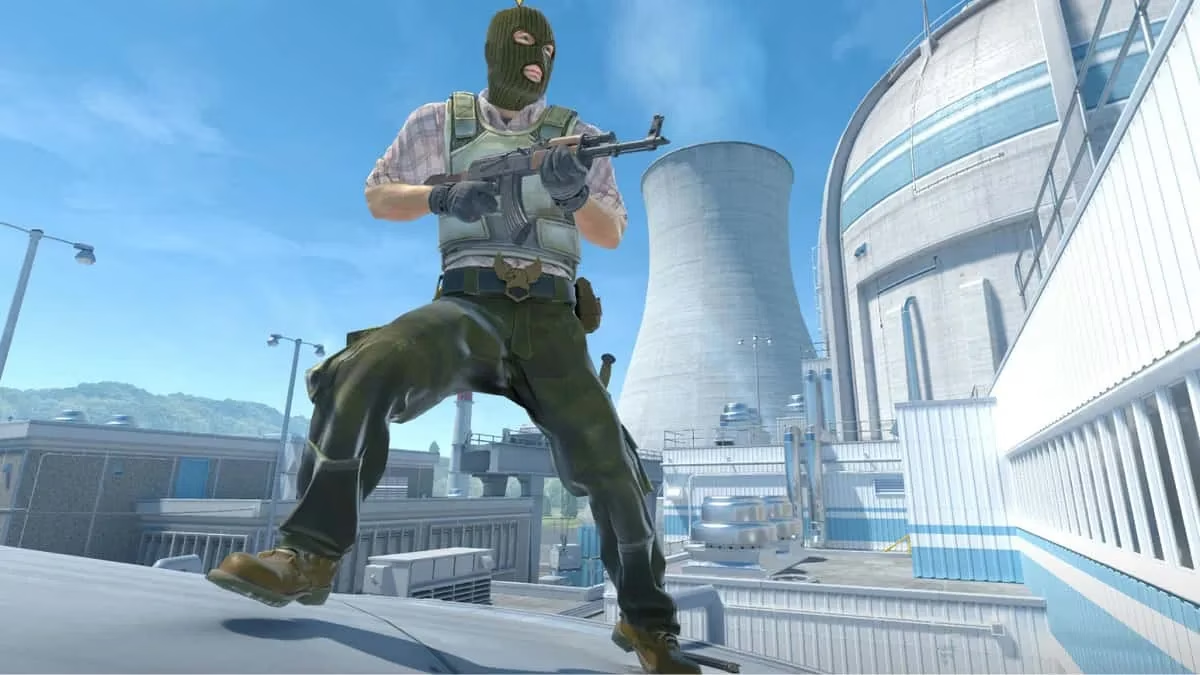
The stage was set on Anubis, a map known for its tight corridors and punishing chokepoints, where a single misstep can unravel the most disciplined strategies. But on that day, neither M80 nor Fnatic could muster a decisive blow. The first half closed at a symmetrical 6–6, every round a grueling chess match of utility denial and angle-clearance. By regulation’s end, the scoreboard read 12–12, a stalemate that felt less like a conclusion and more like a dare. Overtime began, and with it, a slow descent into the absurd.
A Stalemate That Refused to Die
As the extra rounds piled on, the game took on a life of its own. The Anubis stone walls seemed to absorb every frag and every plant, offering no resolution. Overtime one bled into overtime two, then three… four. The scoreline twisted into a hypnotic echo—each team matching every round win with a defensive stand. Casters, initially riding the drama, began to laugh nervously as the match timer crept past the two-hour mark. The map’s ancient Egyptian motifs, normally a backdrop to swift violence, now felt like a prison, trapping twenty warriors in a loop of resets and replants. Clock mechanics, usually an invisible pulse, became a ticking provocation.
The broadcast room, too, entered uncharted territory. Analysts scrambled to pull records, whispering about a 2023 CS:GO overtime war between Complexity and Astralis that had touched nearly four overtime frames. But this? This was CS2’s new engine, and it was gleefully erasing all precedent. Round 50 came and went. Then round 58. The players’ movements grew tight, not from tension alone, but from a far more primal pressure building in the background…
When Nature Comes Calling
Then, in round 64—overtime seven, a full two hours and twenty-five minutes into the match—the lobby suddenly shifted. As revealed later by the casting team, Fnatic’s player bodyy typed into the all-chat a question that somehow captured the entire server’s unspoken agony: “Does anyone else need the toilet?” It was a simple, almost childlike inquiry, yet it landed like a flashbang in a dark room. Almost immediately, the responses flooded in. Everyone did. One M80 player confessed he had been holding it in for the past twenty rounds—a feat of physical endurance that rivaled any in-game clutch. The phrase “bursting” barely covered it.
It was a moment of pure, human comedy layered onto the hyper-professional veneer of Tier 1 Counter-Strike. Here were elite athletes who had trained their reflexes to superhuman levels, but right then, they were all just… people. People who desperately needed a bathroom. The casters, trying to maintain professionalism, couldn’t suppress their grins as they relayed the exchange. You could almost hear the collective sigh of relief when the referees granted the pause, a permission slip signed by commonsense itself.
The Broadcast’s Own Pit Stop
What followed was a delightfully chaotic five-minute intermission. Instead of analyst desk breakdowns, the official broadcast simply… took a break. The cameras pulled back, the stream visuals went into a holding pattern, and thousands of viewers around the world were treated to an unexpected, shared moment of levity. Chat exploded with toilet emojis, frantic memes, and the kind of unhinged glee that only a truly absurd esports moment can inspire. On the server, you could hear actual cheering as the players stood up, their chairs scraping back in stereo—an audio cue more cathartic than any round-win celebration. The break was less an interruption and more a communal exhale, the map’s iron grip momentarily loosened.
Return to the Grind
When the players returned, the landscape had shifted but the deadlock remained. Overtime seven finished without a victor, pushing the battle into overtime eight. Now, however, the physical reset seemed to sharpen M80’s focus. Slowly, meticulously, they chipped away at Fnatic’s defenses, their legs no longer crossed, their minds unclouded by the urgent whisper of biology. The final nail came at a towering 37–34, a score more akin to a basketball game than a CS2 match. After nearly three hours, Anubis finally yielded a winner. The second map, Inferno, flirted with its own overtime but mercifully halted at 16–13, delivering a clean 2–0 series win for M80. Yet that second map felt like a footnote; Anubis had already etched the day into legend.
A Record That Still Stands
As of 2026, no professional CS2 match has come close to that epic. The record for the longest pro game still belongs to that spiraling duel on Anubis, a testament to two benefits: the razor-thin margins that can exist in elite play, and the quiet genius of a mid-match bathroom pause. It’s a record spoken of with a smirk—because it’s impossible to separate the staggering duration from the image of ten world-class players practically crossing their legs at their battlestations. The moment has become a touchstone, proof that even in the glow of 240Hz monitors and perfect crosshair placement, the most universal of human needs will always, eventually, win the round. And perhaps that’s what makes esports truly beautiful: behind every kill, every smoke lineup, every overtime heartbreak, there’s still a person who, at round 70, just really has to go.