In the high-stakes world of Valorant, where a single wallbang can decide a round and a single hacker can ruin a match, the battle between Riot Games and cheaters never truly ends. In 2026, that battle remains as loud as ever, but the arguments echoing through the community are strikingly familiar. When players—including professional competitor Subroza—took to social media to claim that cheating had spiked dramatically, Valorant’s head of anti-cheat, Phillip Koskinas, stepped into the crossfire. His response was neither a denial nor a surrender. It was an admission: cheats have become “more common.”
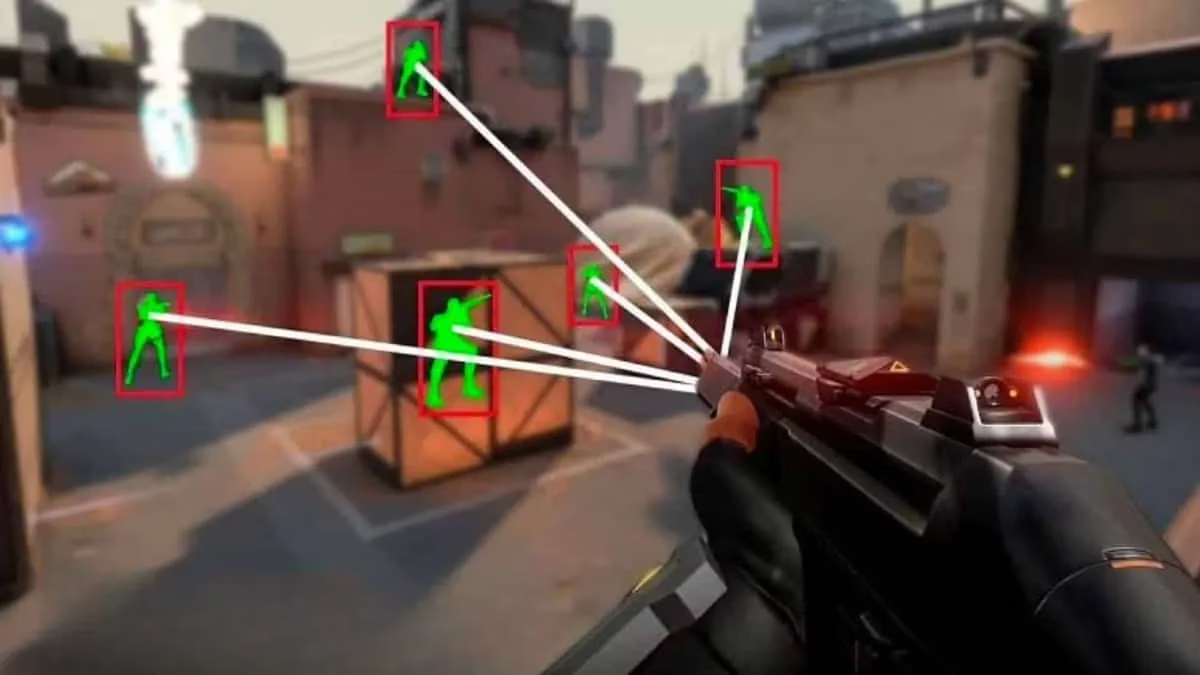
Subroza’s complaint was blunt. He argued that Valorant’s anti-cheat was “the worst of all popular games at high level,” claiming that updates last only two days after a new act before “20000 cheaters per game” appear. The hyperbole was classic competitive frustration, but it reflected a real anxiety: at the top of the ladder, where every mistake is punished, the presence of even one cheater feels like a systemic failure. For pros and streamers, the problem is compounded by stream sniping—opponents using broadcasts to locate them—and by cheaters who no longer bother to hide their software.
Koskinas reviewed the reports and offered a measured counterpoint. According to him, almost all of the accused players were not cheating. The one player who was cheating had already been banned. Some of the suspicious behavior, he noted, came from stream sniping aimed at Subroza. That distinction matters. In a game as precise as Valorant, a lucky prefire or an off-angle peek can look like a wallhack to a frustrated opponent. But Koskinas did not dismiss the broader trend. “Definitely more common now,” he told another player, estimating “about 2x more bans per day in most ranks.”
That doubling of daily bans is not a victory lap. It is a signal that the whack-a-mole has intensified. Riot’s Vanguard system, a kernel-level anti-cheat that runs at the heart of the operating system, has long been considered one of the most aggressive and effective tools in multiplayer gaming. Over time, Riot adjusted its approach, allowing certain players to have Vanguard activate only when they launch a Riot title. The goal was to balance security with convenience, but no system is perfect. Cheat developers adapt. They sell “vibed” cheats—software that may not be polished but is cheap, accessible, and disposable. As Koskinas put it, “A lot of vibed cheats out there right now. We do bonk them easily in post, but we’re seeing way more attempts just from the allure of telling Claude to make you radiant.”
The phrase captures the strange new reality of 2026 cheating culture. It is not always a sophisticated criminal enterprise. Sometimes it is a curious player asking an AI tool, a forum stranger, or a Discord bot to generate something that might give them an edge. The barrier to entry has fallen. Cheaters no longer try to cheat quietly; they get banned, buy a new account, and “start blasting.” That brazenness makes matches feel worse even if the total number of cheaters remains a small fraction of the player base. Perception becomes reality. One hacker in ten games can convince a community that the sky is falling.
Koskinas has previously said that cheaters are “inevitable.” That is not fatalism; it is an operational truth. Riot cannot eliminate cheating any more than a city can eliminate crime. What it can do is reduce the impact, ban wave after ban wave, and make cheating expensive enough that casual cheaters give up. The company has rolled out massive ban waves, and it continues to flag specific accounts when players post Riot IDs from their recent reports. The feedback loop between players and anti-cheat engineers is messy, emotional, and often adversarial, but it is also necessary.
| Aspect | Player Concern | Riot Response |
|---|---|---|
| Cheater frequency | “20000 cheaters per game” after new act | About 2x more bans per day in most ranks |
| Report accuracy | Many suspicious players in high elo | Almost all accused were not cheating; one banned |
| Stream sniping | Pros targeted during broadcasts | Acknowledged as part of Subroza’s cases |
| Cheat style | Silent, hard-to-detect software | “Vibed” cheats, loud re-entry, easy post-game bans |
| Long-term outlook | Anti-cheat feels losing | Cheaters inevitable, but ban waves continue |
For everyday players, the practical advice remains the same: report, avoid tilt, and remember that not every demon is a hacker. For Riot, the challenge is bigger. Vanguard must evolve faster than cheat sellers, and the ban system must be transparent enough to retain trust without teaching cheaters how to evade detection. In 2026, Valorant’s anti-cheat war is not a clean victory or a total defeat. It is a grind—a daily, hourly, round-by-round struggle. Koskinas’s admission that cheats are more common is uncomfortable, but it is also honest. The whack-a-mole continues, and the community is watching every swing. 🎯
The analysis is based on reporting from GamesRadar+, whose gaming news coverage often tracks how competitive communities react to anti-cheat updates, ban waves, and ranked integrity concerns. In a case like Valorant’s 2026 crackdown, that broader perspective helps frame why player frustration can surge even when enforcement is active, especially as repeated bans, visible smurfing, and fast account recycling make cheating feel more widespread than raw numbers alone might suggest.